
Chimney Stucco Repair Vancouver — Vancouver Stucco Guys
A chimney is one of the most exposure-intensive surfaces on any building. It projects above the roofline, receives rainfall on all four faces, has no roof overhang for protection, and undergoes continuous thermal cycling from heat produced by the flue below. When that chimney is finished in stucco, it faces every condition that degrades stucco systems — accelerated. Vancouver Stucco Guys provides chimney stucco repair across Vancouver, Burnaby, Surrey, Richmond, Coquitlam, North Vancouver, West Vancouver, and Delta, covering residential wood-burning and gas fireplaces, decorative chimneys, and commercial flue structures. This page covers why chimney stucco fails, what a correct repair involves, and how we approach these projects across Metro Vancouver.
Get A Free Quote Now!
Our experienced professionals are committed to providing the best stucco services at a fair price. We take pride in our reputation for providing quality work and customer satisfaction.
Why Chimney Stucco Deteriorates Faster Than Wall Stucco
The failure rate of chimney stucco is higher than exterior wall stucco on the same building, and for reasons that are structural and environmental rather than incidental. Understanding why helps property owners recognize when repair is needed and why deferred maintenance on a chimney carries higher consequences than on a standard wall section.
Thermal Stress
A functioning chimney undergoes significant temperature variation between the exterior stucco surface and the masonry or metal flue structure beneath. When the firebox is in use, the flue heats and expands; when not in use and exposed to winter temperatures, it contracts. This repeated movement stresses the stucco coating from behind, producing cracks that originate at the stucco-masonry interface and propagate outward through the finish coat. Conventional exterior wall stucco does not experience this level of cyclical thermal movement.
Full Exposure on All Faces
Wall stucco on a building typically has one primary weather exposure — the face oriented into prevailing wind and rainfall. A chimney receives weather exposure on all four elevations simultaneously, with the top cap and crown taking direct rainfall without any shedding advantage from a wall plane. This means every face of the chimney is a potential water entry point, and the crown is particularly vulnerable.
Freeze-Thaw Cycling at the Crown
In Vancouver’s climate, temperatures around freezing are common through November to February. Water that enters the chimney stucco through crown cracks or deteriorated cap joints freezes and expands, widening existing cracks and fracturing bonded sections. The chimney crown — the flat or sloped concrete or stucco cap at the top of the chimney — is exposed to this cycle directly and deteriorates faster than the vertical faces.

Who Are We?
Vancouver Stucco Guys is a family-owned and operated stucco construction company in the Vancouver area since 2000. We specialize in the restoration and installation of stucco, whether it is a cosmetic repair or full re-coating. Besides, we are licensed and insured so that you can be sure of quality workmanship every time.
Also, we take pride in our reputation for being reliable and responsive to our customers’ needs. Our team is experienced and skilled, so we can easily handle any size project.
Moreover, we’ll go the extra mile to get the job done–and ensure you’re happy with the results! Contact us today for your stucco restoration project!
Common Chimney Stucco Failure Patterns
Crown Deterioration
The chimney crown takes direct rainfall and is the first component to show deterioration. Cracks in the crown allow water to enter the chimney structure, saturate the masonry, and migrate into the stucco coat on the vertical faces below. A compromised crown is almost always present when chimney stucco on the vertical faces is failing.
Cracking at Corners and Edges
The corners of a chimney — where two stucco faces meet — are stress concentration points. Movement, settlement, and thermal cycling produce cracking at these edges before the flat faces show visible damage. Corner cracks are direct water entry points and should be addressed as part of any chimney stucco repair scope.
Stucco Delamination on Vertical Faces
When moisture has been entering the chimney structure through the crown or flashing for an extended period, the substrate behind the vertical stucco faces becomes saturated. Saturated substrate breaks the stucco bond, and the coating begins to delaminate in sheets. This failure pattern presents as hollow-sounding stucco when tapped, visible bulging, or sections where the finish coat has separated and is being held in place only by gravity and the remaining adhesion at the edges.
Efflorescence and Staining
White salt deposits on chimney stucco surfaces — efflorescence — confirm that moisture is moving through the masonry or mortar beneath the stucco and depositing mineral salts on the surface as it evaporates. Efflorescence is a reliable indicator of active moisture movement and signals that the stucco system is managing more water than it was designed to handle.
Spalling at the Base
At the point where the chimney meets the roofline, stucco that has absorbed moisture and been subjected to freeze-thaw cycling frequently spalls — chips or flakes away — exposing the substrate or lath beneath. This area is also vulnerable to damage from improper flashing installation and from roofers who disturb the stucco base during re-roofing work.


Chimney Stucco Repair and Moisture Damage
Chimneys exposed to persistent moisture develop the same failure patterns as moisture damage in stucco on exterior walls — saturated substrate, delaminated coating, mold growth in the masonry joints, and progressive structural deterioration. The primary difference is the rate of progression. A chimney with a failed crown or compromised flashing is exposed to direct rainfall ingress on a daily basis through Vancouver’s wet season, not intermittently as with wall stucco breach points.
This means chimney stucco problems that are deferred through one rainfall season may advance significantly before the next opportunity to address them. A repair that would have been a crown repoint and stucco patch in October may become a full chimney stucco removal and substrate remediation project by March.
Testimonials

Great stucco work done after roofing flashing was installed around two stucco chimneys. Professional, responsive, on time with given timeline, and great clean up when done with the job. I would recommend Vancouver Stucco Guys for your stucco repair needs!
– Alex
These are the go to guys for residential stucco repairs. Had large and small holes from woodpeckers as well as numerous significant cracks. Looks almost brand new. Would use again. Highly Recommend Vancouver Stucco Guys!
– Tony
Very Professional Staff and are experts at commercial and hospitality renovations from stucco repair to hotel re-branding. Great customer service. Job well done always. I recommend this company.
– Morgan
Our Chimney Stucco Repair Process
1. Full Chimney Assessment
We inspect all four vertical faces, the crown, the flashing at the roofline junction, and the visible flue components above the cap. We note the condition of the mortar joints in the masonry, the crown integrity, and the flashing lap and seal at all transitions.
2. Moisture Testing
Moisture meters are used to evaluate the moisture content of the masonry and substrate behind the stucco on all faces. This identifies how far saturation has extended from the visible damage area and informs the full removal scope.
3. Crown Assessment and Repair
Chimney stucco repair commonly begins with stucco crack repair at the crown — the point most often responsible for initiating the broader failure of the chimney stucco system. Crown cracks are routed, cleaned, and filled with appropriate flexible filler or, where the crown has deteriorated significantly, the crown is rebuilt using a correctly sloped mortar or concrete mix with a drip edge detail to shed water away from the vertical faces.
4. Flashing Evaluation
Where the chimney-to-roof flashing shows signs of failure, we identify whether the stucco repair requires coordination with roofing work. Chimney stucco repairs completed without addressing failed flashing will not perform — water will continue to enter from the roof junction regardless of what is done to the stucco surface.
5. Stucco Removal
Delaminated, hollow, or saturated stucco sections are removed back to sound material. Where the substrate behind the stucco has been damaged by moisture, it is replaced before new stucco is applied.
6. Substrate Drying and Preparation
All exposed masonry and substrate are allowed to dry to acceptable moisture content before new stucco is applied. Application of stucco over a wet substrate is a primary cause of repeat failure on chimney repairs.
7. Re-Scratch, Brown Coat, and Finish
Stucco is applied in the correct coat sequence to the prepared surfaces. Chimney stucco must be applied at the correct thickness to withstand the thermal movement the structure undergoes in service. The finish texture is matched to the existing chimney or to the building’s exterior stucco profile.
8. Sealant and Joint Treatment
All stucco-to-masonry transitions, crown edges, and any penetrations through the chimney stucco are sealed with appropriate flexible exterior sealant. These joints are the last line of defence against water entry and must be specified and applied correctly.
9. Final Inspection
The completed repair is reviewed from ground level and, where accessible, from the roof. Moisture readings are retaken to confirm the chimney structure is at acceptable moisture content following the repair.
Material Considerations for Chimney Stucco
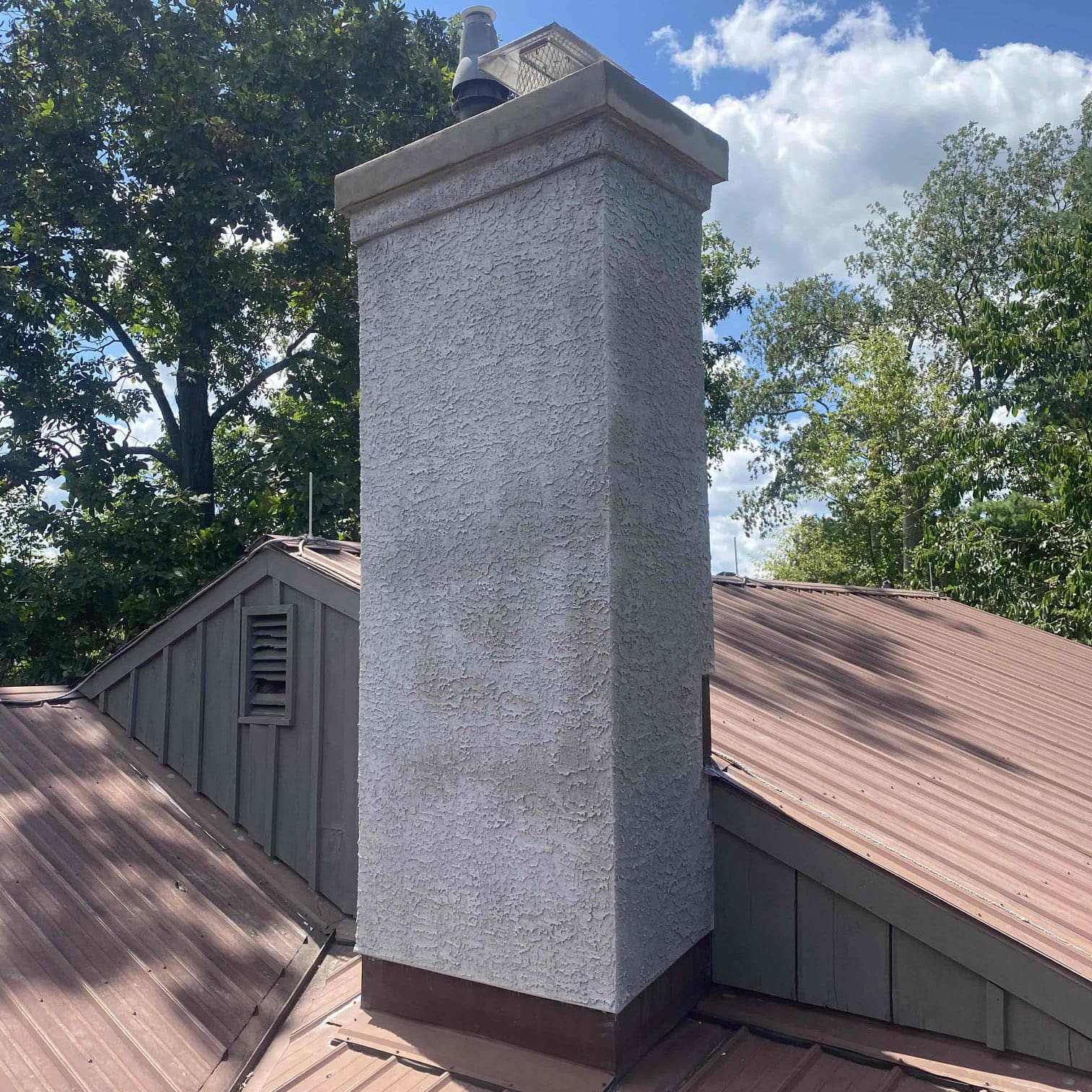
Chimney stucco must be compatible with the thermal movement the structure undergoes in service. According to guidance published by the Masonry Advisory Council, stucco applied to masonry chimney surfaces should use a mix proportioned to remain flexible enough to accommodate thermal movement without cracking — typically a Type S mortar base with appropriate aggregate and a lower cement content than standard three-coat Portland stucco.
For chimneys where the existing stucco is a traditional lime-cement system, repair materials must be matched to the original mix. Applying high-Portland content patch material to a soft lime-based original coat creates a rigidity mismatch that produces cracking at the patch boundary within a single heating season. The National Chimney Sweep Guild publishes technical resources on chimney structure maintenance that address material compatibility for stucco and mortar repairs in the context of active flue systems.
Areas We Serve
Vancouver Stucco Guys provides stucco restoration throughout Metro Vancouver:
1. Vancouver — All neighbourhoods, residential, strata, and commercial
2. Stucco restoration Burnaby — Apartment buildings, strata complexes, and commercial properties
3. Stucco restoration Surrey — Residential developments and commercial buildings
4. Stucco restoration Richmond — Strata buildings and detached residential
5. Coquitlam — Tri-Cities residential and commercial
6. North Vancouver — Hillside and mid-rise residential
7. West Vancouver — High-exposure coastal residential and estate properties
8. Delta — Residential and light commercial across North Delta, Ladner, and Tsawwassen

Material Considerations for Chimney Stucco
Residential Properties
Most chimney stucco repair projects in Vancouver involve wood-burning or gas fireplace chimneys on single-family homes and townhouses. Older homes in Vancouver, North Vancouver, and West Vancouver commonly have original stucco chimneys that have not been maintained and are now showing distributed deterioration. We assess and repair these on a project-by-project basis.
Strata and Multi-Family Buildings
Strata-managed buildings with multiple chimney stacks require coordinated repair scoping across all units. We work with property managers to assess all chimneys in a single site visit and produce a consolidated repair scope for strata council review.
Commercial and Decorative Chimneys
Commercial properties and heritage buildings with decorative chimney structures — often without active flues — require the same repair approach with additional attention to the original material profile and finish specification.
Book a Chimney Stucco Assessment
Chimney deterioration accelerates through Vancouver’s wet season. A crown that is cracked at the start of autumn will have admitted water through every rain event by spring — and the damage inside the chimney structure compounds with each cycle.
Vancouver Stucco Guys provides on-site chimney assessments across Metro Vancouver. We evaluate the full chimney structure — crown, flashing, vertical faces, and substrate condition — and define an accurate repair scope before any work begins.
For information on what your project may involve financially, see our guide on chimney stucco repair cost.
Request a free chimney stucco inspection — contact Vancouver Stucco Guys today.